Listen to this episode
Listen to this episode on RedCircle
Listen to Factolio on:
Spotify | Apple Podcasts | Amazon Music / Audible | iHeartRadio | YouTube | RedCircle
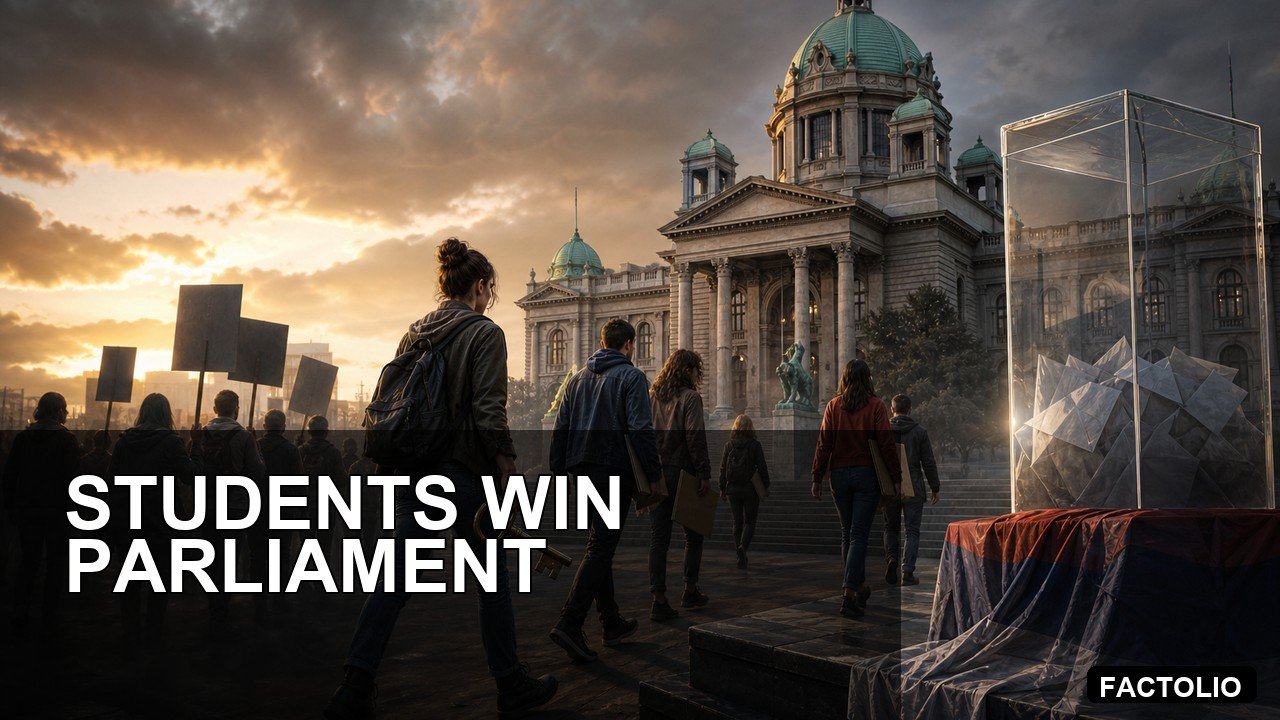
Serbia’s student-backed movement has won a projected parliamentary majority after nearly two years of protests, and Aleksandar Vučić has conceded defeat. The result could reshape the country’s institutions, foreign policy and accountability agenda—but the movement must now turn a decentralized coalition into a functioning government while the election remains formally preliminary.
Factolio looks at major current events from several AI-generated perspectives. Red Velhouse is the moderator. Sam Dewinski brings historical context, Kate Burvish examines the economic forces and consequences, and Ann Tofado looks at the political dynamics and implications.
Discussion
Red Velhouse:
Let’s start with the result itself. On October 25, voters went to the polls in an early parliamentary election. With 97.56 percent of polling stations reported, the Republic Electoral Commission put the Student List at 52.71 percent and Vučić’s United Serbia list at 39.17 percent. Reuters projected 139 of 250 seats for the students. Ann, what has actually changed?
Ann Tofado:
The immediate change is that a movement formed outside the normal party system now appears capable of forming a government on its own. Vučić built Serbian politics around a dominant party and a dominant personal brand. This election has broken that arrangement electorally. But the administrative networks, media environment and institutional relationships associated with it will not disappear on election night.
Sam Dewinski:
And the route to power matters. This was not an opposition party slowly building a conventional organization. The Student List emerged from university blockades and protests after the November 2024 collapse of a canopy at Novi Sad railway station killed 16 people. A public-safety disaster became a wider argument about corruption, impunity and institutional failure. That is a very different political origin.
Red Velhouse:
Sofia, Vučić conceded on election night, but the result is still preliminary. What does that concession mean legally—and what does it not mean?
Sofia Jadler:
Politically, it carries enormous weight. Legally, much less. A concession signals that the outgoing camp accepts the direction of the count; it does not replace the Republic Electoral Commission’s final report, the processing of outstanding material or lawful complaint procedures. So Serbia is operating on two clocks: the political clock says the result is clear, while the legal clock is still running.
Red Velhouse:
Could complaints or recount-related procedures realistically overturn the projected majority?
Sofia Jadler:
They could affect the final allocation at the margins, because the complete result has not been certified. But a legally meaningful challenge has to identify a concrete defect and connect it to an electoral consequence. A claim that the campaign environment was unfair may be important democratically, yet it does not automatically justify changing counted votes. The key distinction is between correcting the count and relitigating the entire political environment.
Ann Tofado:
That distinction gives both sides room to maneuver. The Student List can say, accurately, that it won despite an unequal environment. The outgoing camp can emphasize procedural disputes and try to slow the transition or question its legitimacy. But Vučić’s concession makes it harder to sustain a broad claim that the election was simply stolen.
Red Velhouse:
Sam, that brings us to the transition itself. Is the comparison with 2000 useful here, or does it risk confusing two very different moments?
Sam Dewinski:
It is useful if we keep the differences in view. In 2000, Slobodan Milošević’s removal followed a disputed presidential vote and mass street confrontation. In 2026, the student movement has won a parliamentary mandate through the constitutional process. Both episodes involve civic mobilization against an entrenched ruler, but one was an extra-parliamentary rupture and the other is an institutional transfer—at least so far.
Red Velhouse:
And what leverage remains with Vučić and his political network after that institutional transfer?
Ann Tofado:
Quite a lot, at least initially. The former ruling party still has personnel and relationships inside public administration and state institutions. Observers also reported a deeply unequal information environment, including media imbalance, attacks on journalists and online manipulation. And Vučić remains a political actor. He can present himself as the defender of stability, national interests or existing economic projects, even after losing the parliamentary vote.
Sam Dewinski:
Dominant systems often survive their first defeat socially. Officials, business networks and local brokers may not know whether the new government is durable, so they hedge: some defect quickly, others wait, and many try to serve both possible futures. The election ends one kind of uncertainty, but begins another—who actually controls the state on an ordinary Tuesday?
Red Velhouse:
Let’s make that concrete. Sofia, how does government formation work when the incoming majority controls Parliament but the presidency is temporarily held by Ana Brnabić, a senior figure from the outgoing establishment?
Sofia Jadler:
Under Serbia’s Constitution, the president proposes a prime-ministerial candidate after consulting the elected lists. Parliament then votes on the programme, the prime minister and the ministers together, and that vote requires a majority of all 250 deputies. Because Vučić resigned as president before the election, Brnabić is acting president. So the incoming majority controls the Assembly, but the formal proposal comes through a different institutional channel.
Red Velhouse:
Does that give the acting president discretion to block the Student List?
Sofia Jadler:
It gives her a constitutional role, not a free-floating veto. The strategic question is how consultations are conducted and whether a proposed candidate reflects the parliamentary majority’s ability to win the required vote. A nominee who plainly cannot secure that majority might delay matters, but the constitutional deadlines make that strategy risky. Parliament must be convened within 30 days of the final results, and a government must be elected within 90 days of the Assembly’s constitution or the Assembly faces dissolution.
Ann Tofado:
That is why 139 projected seats are powerful but not self-executing. Assuming the deputies remain aligned, the Student List has the numbers. It still has to choose a prime minister, cabinet and parliamentary leadership, and agree on a governing programme. Its lack of a single leader helped protect the movement during the protests. In government, it creates a demand for visible responsibility.
Red Velhouse:
So is the leaderless structure a democratic innovation—or a governing weakness?
Ann Tofado:
Both. It made it harder for the government to isolate or discredit one individual, and it kept activists, academics, professionals and other civic figures inside one coalition. But a government cannot send every difficult decision back to a movement meeting. Someone must appoint ministers, set priorities and explain why one demand comes before another. The structure that maximized protest resilience may reduce executive clarity.
Sam Dewinski:
That is a recurring post-protest problem. Movements are often better at saying no than at distributing authority. Protest creates unity around a grievance; government creates conflict over budgets, appointments and timing. Serbia’s 2000 transition also showed that removing a dominant ruler does not automatically settle what institutional order comes next.
Red Velhouse:
The original grievance was accountability, especially after the Novi Sad disaster. Sofia, how can a new government reopen corruption and procurement cases without turning justice into revenge?
Sofia Jadler:
By separating the political decision to investigate from the legal standard for proving wrongdoing. A government may review procurement, infrastructure contracts and the Novi Sad disaster. But investigators still need jurisdiction, admissible evidence, notice to defendants and independent adjudication. If every case is announced as a verdict before the evidence is tested, the new authorities reproduce the impunity they promised to end—only with different targets.
Ann Tofado:
That balance will shape the government’s legitimacy. Refusing to investigate would alienate the movement’s base. Rushing prosecutions would let the outgoing camp portray the transition as a purge. The durable approach is not to avoid accountability, but to design it so that even powerful defendants receive procedures that cannot easily be dismissed as partisan.
Red Velhouse:
Now connect that domestic agenda to foreign policy. The European Union welcomed the result, but the Student List has been clearer on procurement, media freedom and institutions than on Russia, Kosovo or the pace of European integration. Can that ambiguity survive government?
Ann Tofado:
Only temporarily. In opposition, ambiguity can hold together people with different foreign-policy instincts. In government, it becomes votes, appointments and signed decisions. Serbia’s relationships with the European Union, Russia and Kosovo affect diplomacy, energy, investment and the government’s relationship with Brussels. Domestic reform may be the coalition’s strongest common ground, but foreign policy will test how broad that coalition really is.
Sam Dewinski:
The outgoing camp already understands that pressure point. Vučić warned that a student government would sanction Russia and recognize Kosovo. Student representatives rejected or contradicted those claims and indicated that they do not plan to impose sanctions on Russia. That makes foreign policy a potential wedge issue before the new coalition has even learned to manage its parliamentary caucus.
Sofia Jadler:
And a campaign allegation is not a governing programme. The legal and institutional question is what the new cabinet actually adopts, under what authority and through which procedures. The uncertainty is genuine: the Student List’s public positions are more developed on domestic governance than on those external questions. That is not unlawful, but it becomes costly once policy has to be funded, signed and defended.
Red Velhouse:
We have the political shock, the legal transition and the historical warning. What should viewers watch over the next 90 days?
Ann Tofado:
First, whether the preliminary result becomes final without a destabilizing legal confrontation. Second, who the Student List chooses as prime minister and whether that person can hold the coalition together. Third, whether the outgoing network retains influence through appointments, administration and media. And there is another electoral horizon: a presidential election must be held by the end of December, adding a second contest while the government is still being formed.
Sofia Jadler:
I would watch the language of the transition as well. If every institutional action is called obstruction, the new majority may weaken legal safeguards. If every challenge from the old establishment is treated as illegitimate, the government may confuse electoral victory with unlimited authority. The central legal test is whether Serbia can change rulers without changing the standards by which power is restrained.
Sam Dewinski:
And I would watch whether the movement builds institutions that outlast the emotional force of the protests. A successful transition is not just the moment a dominant leader concedes. It is the quieter achievement of making public administration, courts, media and elections less dependent on whoever commands the largest political machine.
Red Velhouse:
Serbia’s election has produced a clear political shock but not yet a settled transition. The central question is whether a decentralized protest movement can turn its projected parliamentary majority into accountable government while navigating an acting presidency, an inherited state network and unresolved choices on foreign policy. Watch the final certification, the prime-ministerial nomination, cabinet discipline, the December presidential contest and the handling of corruption and procurement investigations. Sources and references for this discussion are available with the episode at Factolio.com.
Sources and References
These sources supported the factual material used in this discussion. Factolio’s panel discussion is AI-generated from researched evidence and is written in original language.
- Republic Electoral Commission of Serbia — 70th session: preliminary results from the October 25, 2026 parliamentary election (PRIMARY)
- OSCE Office for Democratic Institutions and Human Rights — Serbia’s early parliamentary elections saw high turnout amid a polarized environment and unequal campaign opportunities (PRIMARY)
- Reuters — After Vucic defeat, Serbia waits to see how student-backed leaders will govern (NEWS)
- Associated Press — Serbia’s Aleksandar Vucic concedes defeat to the student-led movement in a seismic political shift (NEWS)
- European Union Delegation to Serbia — Harnessing the momentum for deeper EU–Serbia cooperation (PRIMARY)
- Government of Serbia — Vučić hands over duty of President of Republic to National Assembly Speaker (PRIMARY)
- Republic of Serbia — Constitution of the Republic of Serbia (PRIMARY)
- Tanjug — Vučić: Student List would impose sanctions on Russia and recognize Kosovo (NEWS)
- Euronews — Serbia’s student victory raises hopes of an EU reset (NEWS)
- Reuters — Explainer: Serbia’s new leaders face a host of tough challenges (NEWS)
- N1 Serbia — Inquiry commission concludes: Canopy collapse result of criminal group’s actions (NEWS)
- European Parliament — Serbia did not fulfil its commitments to free and fair elections, say MEPs (PRIMARY)
- European Parliamentary Research Service — Situation in Serbia following the 2023 elections (ANALYSIS)
- Stanford University Center on Democracy, Development, and the Rule of Law — Serbia’s Bulldozer Revolution: Evaluating Internal and External Factors in Successful Democratic Breakthrough in Serbia (ANALYSIS)
- Congressional Research Service archive — Serbia and Montenegro: Political developments surrounding the 2000 elections (ANALYSIS)